Essential Series
12V 334Ah MC Essential Series LiFePO4 Battery (4.28kWh)
$1,299
IP21BluetoothHeatedVictron Comms
Capacity: 334Ah
- 11-year limited warranty: 3 years free replacement
- US-based support
- Available to ship today
Features at a glance
- IP21Indoor rated
Built for dry, protected indoor installs. Not weatherproof or waterproof.
- 4,500+Cycle life
Over 12 years at one full cycle a day. Rated at the depth of discharge, charge rate and temperature stated on the datasheet, to its end-of-life capacity.
- iOS + AndroidBluetooth app
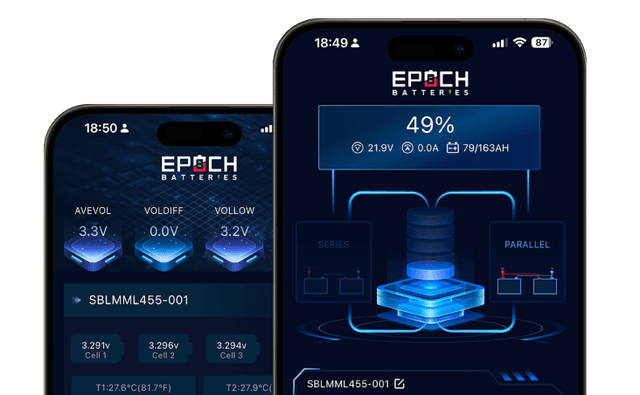
Charge, voltage and temperature on your phone in the Epoch Li-Ion app.
- Advanced BMSProtection
Guards against overcharge, over-discharge, overcurrent and short circuit.
- Self-heatingCold weather
Warms its cells before charging, so it can charge in freezing weather.
- LiFePO4Thermal stability
Lithium iron phosphate has a far lower thermal-runaway risk than other lithium chemistries. The BMS adds over-temperature and low-temperature charge protection.
- 12V 334Ah MC Essential Series LiFePO4 (4.28kWh): High-capacity heated deep-cycle house power for RVs, vans, off-grid cabins and solar banks, storing 4,275Wh (nominal) in one metal-cased battery built for dry, protected interior spaces.
- VICTRON CAN COMMS: Speaks the Victron CAN-bus protocol. Wired to a Cerbo GX or Ekrano GX, the host battery becomes the controlling BMS and sets the chargers' voltage and current limits through DVCC. Batteries link over RJ45 patch cables and negotiate their host or node role automatically, with no DIP switches or addresses, and the GX shows the whole bank as one battery.
- High-Output Power Delivery: 300A max continuous discharge (150A recommended for daily use) and 600A peak for up to 10 seconds for start-up surges. At 12.8V, 300A is about 3,840W of DC output before inverter losses, enough for a properly designed 3,000W-class inverter system. Accepts up to 300A continuous charge (167A recommended).
- HEATED for Cold-Weather Charging: Charges from -20°C to 55°C (-4°F to 131°F) with its internal heating film. With a charger connected and the cells below 0°C (32°F), the heater warms them and the BMS holds off charge current until they are above 5°C (41°F), which can take up to 60 minutes. The heater runs only while a charger is connected.
- BLUETOOTH Monitoring: The free Epoch Li-Ion app for iOS and Android shows state of charge, voltage, current, cell voltages, temperatures, heater status and protection history.
- 2A Active Cell Balancing: Moves charge between the four cells across the full state-of-charge range to keep their voltages matched.
- Smart BMS Protection: Built-in protection against overcharge, over-discharge, over-current, short circuit and high or low temperature.
- Parallel Expansion, No Series: Up to 4 matched batteries in parallel are validated plug and play (1,336Ah / 17.10kWh); larger banks, up to 16 (5,344Ah / 68.40kWh), need Epoch design support. Series wiring is not approved for this model.
- IP21 Indoor Metal Case: Powder-coated steel, 15.35 × 8.07 × 11.02 in (390 × 205 × 280 mm), 75 lb (34 kg). IP21 protects against fingers and vertically dripping water only: install it upright in a dry, protected interior space, never in engine bays, exterior bays or anywhere it can be sprayed or submerged.
- 4,500+ Cycle Life & 11-Year Limited Warranty: No watering or acid service, backed by an 11-year limited warranty (3 years of free replacement, then 40% off MSRP on a replacement battery through Year 11; register within 90 days or keep your proof of purchase).
Configuration
Cell Configuration: 4S1P
Chemistry: LiFePO4
Current
Ah Capacity: 334Ah
Max Continuous Discharge Amps: 300A (150A recommended for daily use)
Max Charge Current Amps: 300A (167A recommended)
Max Discharge Peak Current Amps: 600A (up to 10 Seconds)
Series | Parallel: Parallel only: Max (4) in Parallel, up to (16) with Epoch design support; no series
Voltage
Voltage: 12.8V
Max Charge Voltage: 14.6V
Operating Voltage Range: 10.0 - 14.6V
Temperature
Charge Temp Range: -20°C (-4°F) / 55°C (131°F) (with heating)
Discharge Temp Range: -20°C (-4°F) / 60°C (140°F)
Storage Temp: 0°C (32°F) / 35°C (95°F) (recommended)
Weight: 75 (LBS)
Dimensions
Length: 15.35" (inches)
Width: 8.07" (inches)
Height: 11.02" (inches)
Certifications: UL 1642, UL 9540A, IEC 62619:2022
Compliance marks: CE, RoHS
Transport: UN 38.3, Class 9
Maximum Continuous Charge Current: 300A per battery, all charging sources combined
Recommended Charge Current: Up to 167A (0.5C) per battery; up to 50% of bank capacity for parallel banks (334A for 2, 501A for 3, 668A for 4)
Bulk/Absorption: 14.2V-14.4V
Absorption End Condition: Charge current ≤ C/20 (16.7A) or 15 min, whichever comes first
Float Voltage: Disabled (preferred) or 13.3V-13.6V
Re-bulk: 13.2V
Temperature Compensation: 0 mV/°C (disabled)
Equalization: Disabled; do not use lead-acid equalization, desulfation or repair modes
Charge Temperature Range: -20°C to 55°C (-4°F to 131°F) with internal heating; below 0°C (32°F) the heater warms the cells while a charger is connected, and charging resumes above 5°C (41°F)
BMS High Voltage Cutoff: 14.6V
Victron systems with a Cerbo GX or Ekrano GX: connect the host battery's CAN port to the GX BMS-Can port, select the CAN-bus BMS profile (500 kbit/s), turn DVCC on and set the controlling BMS to the battery (listed as DRIFT). The battery then sets the charge voltage and current limits, and the chargers' own absorption, float and tail settings are ignored.
Victron chargers without a GX: program a user-defined 12V LiFePO4 profile in VictronConnect expert mode with the settings in section 9 of the user manual.
NOTE: If a charger cannot be fully programmed, confirm its bulk/absorption voltage is within range and that equalization and temperature compensation are disabled.
Epoch Li-Ion App


Still have questions?
We're here to help! Give us a call and talk with a US-based technical expert.

1/4
Hover to zoom
Downloadable resources
Applications & use cases
- RV house power
- Camper van and skoolie builds
- Travel trailers and fifth wheels
- Motorhomes and Class A or Class C coaches
- Marine house power (protected installation)
- Off-grid solar systems
- Solar battery banks and inverter systems
- Off-grid cabins
- Backup power
- Victron Cerbo GX and Ekrano GX systems
RV · Camper · Van conversion lithium power
Epoch 12V 334Ah MC Essential Series RV Lithium Battery (4.28kWh) | Heated, Bluetooth & Victron CAN
A 12V 334Ah LiFePO4 battery designed for high-capacity van, camper, and RV energy systems that need serious output in a compact footprint.
The Epoch 12V 334Ah MC (model 12334A-MC) stores 4.28kWh (4,275Wh nominal) in one metal-cased battery, built for RVers, camper van builders, and off-grid users who want more boondocking power without sacrificing living space. With 300A continuous discharge, internal heating, Bluetooth monitoring in the Epoch Li-Ion app, Victron CAN communications, 2A active balancing, and a 75 lb, 15.35 × 8.07 × 11.02 in case, it is a high-capacity deep cycle battery for serious 12V power systems.
334Ah
Capacity
4.28kWh
Stored energy
300A
Continuous output
600A
10 sec peak
75 lbs
Battery weight
IP21
Indoor, drip resistant
Built for high-demand RV power systems
11-year limited warranty
3 yrs free replacement
Victron communications
Cerbo GX & Ekrano GX ready
Bluetooth monitoring
Epoch Li-Ion app
Internal heating
Cold-weather charging
2A active balancing
Cell-level stability
300A BMS
Heavy-load output
Power Heavy RV Loads with a 300A Smart BMS
Run a properly designed 3,000W-class inverter system from one compact 12V lithium battery.
This 12V 334Ah LiFePO4 battery is built around a robust 300A continuous discharge rating, giving DIY builders enough output for serious inverter-based RV and van power systems. At 12.8V, 300A is about 3,840W of DC output before inverter losses, enough for a properly designed 3,000W-class inverter system. Size the system by the inverter's DC input current, not its AC output: it must stay within 300A, and Epoch recommends keeping daily loads at or below 150A.
The 600A peak discharge rating covers start-up surges of up to 10 seconds from appliances such as air conditioners, microwaves, and refrigerators; any load that lasts longer must stay at or below 300A. As always, inverter surge, wiring, fuse protection, ventilation, and charger settings must be designed correctly.
Four-Season Ready & Seamless System Integration
Automatic Internal Heating
An internal heating film lets the battery charge from -20°C to 55°C (-4°F to 131°F). When a charging source such as solar, shore power, or a DC-to-DC alternator charger is connected and the cells are below 0°C (32°F), the heater warms them and the BMS holds off charge current until they are above 5°C (41°F), which can take up to 60 minutes in deep cold. The heater runs only while a charger is connected.
Victron Comms & Bluetooth Monitoring
Wired to a Victron Cerbo GX or Ekrano GX over CAN-bus, the host battery becomes the controlling BMS and, with DVCC on, tells MultiPlus, MPPT, and Orion chargers what voltage and current to deliver. Batteries in a bank link over RJ45 patch cables and negotiate their host or node role automatically, so the GX shows the bank as one battery. Over Bluetooth, the free Epoch Li-Ion app shows state of charge, voltage, current, cell voltages, temperatures, and heater status.
Compact, Safe, and Built for the Long Haul
Built for dry interior RV and van installs, such as under-bed, dinette bench, and electrical cabinet power systems.
The 75 lb (34 kg) battery measures 15.35 in × 8.07 in × 11.02 in (390 × 205 × 280 mm) in a powder-coated steel case, making it a practical under-bed RV battery upgrade or cabinet-mounted battery bank for camper vans and off-grid RV conversions. Its IP21 rating covers fingers and vertically dripping water only, so it is for dry, protected indoor installation, not exposed exterior battery trays.
2A active balancing moves charge between the cells across the full state-of-charge range, while the 4,500+ cycle rating and 11-year limited warranty support long-term confidence for demanding mobile and off-grid electrical systems.
Compatible applications
RV, camper, van conversion, solar, and off-grid 12V power systems.
- ✓ RV, camper, motorhome, travel trailer, and fifth-wheel house-power systems.
- ✓ Camper van and skoolie electrical builds that need high capacity without wasting living space.
- ✓ Under-bed RV battery upgrade projects, dinette bench installs, and interior electrical cabinets.
- ✓ Inverter-based boondocking setups for air conditioners, microwaves, induction cooking, and residential refrigerators, within 300A continuous.
- ✓ Off-grid van conversion and solar battery banks using lithium-compatible charge controllers and inverter chargers.
- ✓ Victron Cerbo GX and Ekrano GX systems using CAN communications and DVCC.
- ✓ Protected marine house-power installations and backup power.
- ✓ Parallel 12V banks: 4 batteries validated, larger banks up to 16 with Epoch design support.
Battery features
High-output LiFePO4 performance with smart monitoring, heating, balancing, and Victron support.
334Ah / 4.28kWh capacity
A high-capacity deep cycle battery that stores serious off-grid energy in one compact 12V package.
300A continuous discharge
Supports demanding 12V loads and properly designed 3,000W-class inverter systems; 150A is recommended for daily use.
600A peak discharge
Provides short-duration surge capability for up to 10 seconds to help handle appliance startup loads.
Internal heating
Warms the cells below 0°C (32°F) while a charger is connected; charging resumes above 5°C (41°F), for a -20°C to 55°C charge range.
Victron communications
Acts as the controlling BMS for a Victron Cerbo GX or Ekrano GX over CAN-bus with DVCC; banks link over RJ45.
Bluetooth app monitoring
View state of charge, voltage, current, cell voltages, temperatures, and heater status in the Epoch Li-Ion app for iOS and Android.
2A active balancing
Moves charge between cells across the full state-of-charge range to keep the four cells matched.
IP21 indoor use
For dry, protected RV and van installation spaces such as under beds, benches, or cabinets. Not weatherproof or waterproof.
4,500+ cycle life
Long-lasting LiFePO4 performance for repeated deep-cycle use in mobile and off-grid applications.
Parallel expansion
Up to 4 batteries in parallel, validated plug and play; up to 16 with Epoch design support. No series wiring.
75 lb weight
High capacity without the weight penalty of multiple lead-acid or AGM batteries.
11-year limited warranty
3 years of free replacement, then 40% off MSRP on a replacement battery through Year 11. Register within 90 days or keep your proof of purchase.
Compatible charging equipment
Use lithium-compatible hardware programmed for Epoch’s charging settings. Combined charge current from all sources must stay at or below 300A per battery.
✓
12V LiFePO4 chargers, converters, and inverter chargers with a LiFePO4 or programmable profile
✓
Solar charge controllers (MPPT or PWM) with a programmable or LiFePO4 profile
✓
DC-to-DC alternator chargers for van and RV charging systems
✓
Victron systems with a Cerbo GX or Ekrano GX, where CAN comms let the battery set charge limits through DVCC
Technical Specifications & Dimensions
Full technical details, dimensions, weight, communication features, and charging settings.
| General | |
|---|---|
| Brand | Epoch Batteries |
| Model / SKU | 12334A-MC |
| Series | Essential Series |
| Battery type | Heated Bluetooth deep-cycle LiFePO4 battery with Victron CAN communications |
| Primary use | High-capacity 12V house power for RVs, vans, off-grid cabins, and solar banks, installed in a dry, protected interior space |
| Chemistry | LiFePO4 / Lithium iron phosphate |
| Cell type | Grade-A prismatic LiFePO4 |
| Cell configuration | 4S1P |
| Bluetooth | Yes — Epoch Li-Ion app, iOS and Android |
| Victron communications | Yes — Victron CAN-bus (GX / DVCC) |
| Internal heating | Yes — internal heating film; runs only while a charger is connected |
| Active balancing | Yes — 2A active balancing |
| Cycle life | 4,500+ cycles |
| Warranty | 11-year limited warranty: free replacement in Years 1–3, then 40% off MSRP on a replacement battery in Years 4–11. Register within 90 days or keep your proof of purchase. |
| Voltage and capacity | |
| Nominal voltage | 12.8V |
| Nominal capacity | 334Ah |
| Energy stored | 4.28kWh (4,275Wh) |
| Operating voltage range | 10.0V – 14.6V |
| Maximum charge voltage | 14.6V |
| Current ratings | |
| Max continuous discharge | 300A (150A recommended for daily use) |
| Max continuous charge current | 300A |
| Recommended charge current | Up to 167A (50% of capacity); up to 50% of bank capacity for parallel banks |
| Max discharge peak current | 600A for up to 10 seconds |
| Estimated runtime (80% planning energy, 3,420Wh) | 100W ≈ 34.2 h · 500W ≈ 6.8 h · 1,000W ≈ 3.4 h · 3,000W ≈ 1.1 h |
| Configuration | |
| Series connections | Not approved for this model |
| Parallel connections | Max. 4 batteries (validated); up to 16 with Epoch design support |
| Maximum configuration | 4P: 1,336Ah / 17.10kWh, matched batteries and rated equipment |
| System design note | Use matched 12334A-MC batteries of the same age, capacity, and state of charge, within 0.05V of each other before connecting |
| Temperature | |
| Charge temperature range | -20°C to 55°C / -4°F to 131°F, with heating |
| Discharge temperature range | -20°C to 60°C / -4°F to 140°F |
| Recommended storage temperature | 0°C to 35°C / 32°F to 95°F |
| Low-temperature charge protection | Heater on below 0°C (32°F) while a charger is connected; charging resumes above 5°C (41°F) |
| Dimensions and weight | |
| Length | 15.35 in / 390 mm |
| Width | 8.07 in / 205 mm |
| Height | 11.02 in / 280 mm |
| Overall dimensions | 15.35 in L × 8.07 in W × 11.02 in H (390 × 205 × 280 mm) |
| Weight | 75 lb / 34 kg |
| Mechanical | |
| Case material | Powder-coated steel (metal) enclosure |
| Enclosure protection | IP21 (IEC 60529) — indoor, drip resistant; dry indoor installation only, not submersible |
| Terminal type | M10 female |
| Terminal torque | 13–17 Nm (115–150 in-lb) |
| Mounting orientation | Upright; do not invert during operation |
| In the box | One battery and two M10 stainless terminal bolts with washers |
| Recommended charging settings | |
| Bulk / absorption voltage | 14.2V – 14.4V |
| Absorption time | End when current falls to C/20 (16.7A) or after 15 minutes, whichever comes first |
| Float voltage | 13.3V – 13.6V; disabled is preferred |
| Re-bulk voltage | 13.2V |
| Equalization | Disabled |
| Temperature compensation | 0 mV/°C (disabled) |
| Charge temperature range | -20°C to 55°C / -4°F to 131°F (with internal heating) |
| BMS high voltage cutoff | 14.6V |
| BMS protection | |
| Overcharge protection | Yes |
| Over-discharge protection | Yes |
| Over-current protection | Yes |
| Short-circuit protection | Yes |
| High and low temperature disconnects | Yes |
| Compliance and support | |
| Certifications | UL 1642, UL 9540A, IEC 62619:2022 |
| Compliance marks | CE, RoHS |
| Transport | UN 38.3, Class 9 |
| Support | US-based technical support: 1-888-501-1846, support@epochbatteries.com |
Why upgrade to Epoch LiFePO4?
More usable energy. Less weight. Smarter monitoring. Longer service life.
Compared with traditional lead-acid batteries, LiFePO4 technology provides more usable capacity, stable voltage output, fast charging capability, and maintenance-free operation. For RVers and van builders, that means more boondocking runtime, less battery-bank complexity, and far less space lost to multiple heavy lead-acid batteries.
Fitment and installation note
Verify your inverter, charger, wiring, and installation location before use.
Always confirm compartment dimensions, mounting location, cable clearance, terminal compatibility, fuse sizing, charger settings, inverter draw, and ventilation before installation. For large inverter systems, properly sized cables, bus bars, fuses, disconnects, and charge sources are essential. Use matched batteries within 0.05V of each other and balanced wiring for parallel battery banks. Mount the battery upright, torque the M10 terminals to 13–17 Nm (115–150 in-lb), and place a DC-rated main fuse or breaker within 18 in (45 cm) of the positive terminal.
Frequently asked questions
Epoch 12V 334Ah RV Battery FAQs
Common questions about inverter sizing, Victron integration, installation, heating, parallel banks, and RV fitment.
Can I run my RV air conditioner with this single battery?
Yes, with a properly designed inverter system. The Epoch 12V 334Ah MC uses a heavy-duty 300A continuous BMS. At 12.8V, that is about 3,840W of DC output before inverter losses, enough for a properly designed 3,000W-class inverter system, and its 600A peak rating covers start-up surges of up to 10 seconds. Runtime depends on the load: planning on 80% of the battery's 4,275Wh (3,420Wh), a 1,000W load runs for about 3.4 hours and a 3,000W load for about 1.1 hours.
Does this battery integrate with my Victron system?
Yes. The 12334A-MC speaks the Victron CAN-bus protocol. Connect the host battery's CAN port to the BMS-Can port of a Cerbo GX or Ekrano GX with a straight-through RJ45 patch cable, select the CAN-bus BMS profile (500 kbit/s), turn DVCC on, and choose the battery (listed as DRIFT) as the controlling BMS. In a bank, run a patch cable from each battery's LINK B to the next battery's LINK A; the batteries negotiate their host or node role automatically, and the GX shows the bank as one battery. The BMS then sets the charge voltage and current limits for MultiPlus, MPPT, and Orion chargers.
Where should I install this battery in my van or camper?
Because this model is IP21 rated, it must be installed upright in a dry, protected interior location such as under a van bed, inside a dinette bench, in a dedicated electrical cabinet, or in a protected RV battery bay. It should not be installed in engine bays, exposed exterior locations, wet compartments, or areas where it may be sprayed, submerged, or covered by standing water.
Will the internal heater drain my battery while I am boondocking?
No. The heater runs only while a charging source is connected. When a charger such as solar, shore power, or a DC-to-DC alternator charger is connected and the cells are below 0°C (32°F), the BMS turns on the heater and blocks charge current until the cells are above 5°C (41°F), which can take up to 60 minutes in deep cold. With no charger connected the heater stays off, and the battery can still discharge down to -20°C (-4°F) without heating.
Can I wire these batteries in series or parallel?
Parallel only. Up to 4 matched 12334A-MC batteries in parallel are validated plug and play, for up to 1,336Ah (17.10kWh) at 12.8V; banks of up to 16 batteries need Epoch design support for fusing and busbars. Series connection is not approved for this model, so it must not be used to build 24V, 36V, or 48V systems. Charge each battery fully and bring them all to within 0.05V of each other before connecting them.
How much space and weight will this save compared to lead-acid batteries?
This battery stores 4.28kWh in a single 15.35 in × 8.07 in × 11.02 in footprint and weighs 75 lbs. To get a similar amount of usable energy from traditional lead-acid or AGM batteries, you would typically need several 100Ah batteries weighing well over 200 lbs combined. This makes the 334Ah Epoch battery a major space and weight saver for vans, campers, and RVs.
What is 2A active balancing?
2A active balancing moves charge between the cells to keep their voltages matched across the whole state-of-charge range, not only at full charge. This helps a large-capacity battery stay consistent through repeated heavy inverter loads and deep-cycle use.
Is this a good battery for a 3,000W inverter?
Yes, when the inverter system is properly designed. At 12.8V, the 300A continuous rating is about 3,840W of DC input before inverter losses, enough for a 3,000W-class inverter. Size the system by the inverter's rated DC input current, not its AC output: it must stay within 300A, and Epoch recommends 150A or less for daily use. Wiring, fusing, inverter surge draw, charger settings, and ventilation should be sized by a qualified installer or experienced builder.
More from Essential Series

48V 100Ah V2 Elite Series LiFePO4 Battery (5.12kWh)
14
$2,39948V 100Ah

36V 100Ah LiFePO4 Lithium Battery (3.84kWh)
96
$1,89936V 100Ah

12V 15A Lithium Battery Charger - Epoch Batteries
185
$14912V 15Ah
24V 15A Lithium Battery Charger - Epoch Batteries
61
$16924V 15Ah

36V 15A Lithium Battery Charger - Epoch Batteries
104
$2390

36" CANBUS Cable for GC2 Golf Cart Batteries
10
$100

12V 105Ah Essential Series LiFePO4 Battery (1.34kWh)
164
$54912V 105Ah

12V 300Ah Essential Series LiFePO4 Battery (3.84kWh)
231
$1,24912V 300Ah

12V 50Ah Essential Series LiFePO4 Battery (0.64kWh)
37
$29912V 50Ah

48V to 12V (25A) Voltage Reducer & Step Down Converter
6
$9048V 100Ah

GC2 Battery Lifting Strap & Carrier
$20

4 AWG 24-Inch Battery Cable - Heavy Duty Wire
4
$50

Parallel Busbar
4
$9048V 30Ah
48V 15A Lithium Battery Charger - Epoch Batteries
12
$25948V 15Ah
12V 460Ah V2 Elite Series LiFePO4 Battery (5.89kWh)
134
$2,39912V 460Ah

48V 100Ah (5.12kWh) - Self-Heating Server Rack Lithium Battery
1
$1,49948V 100Ah

Epoch V2 & V2-T Mounting Hardware | 8D Battery Bracket
56
$3012V 460Ah

12V 460Ah Essential Series LiFePO4 Battery (5.89kWh)
157
$1,59912V 460Ah

48V 105Ah Golf Cart Battery Complete Kit - Lithium (LiFePO4)
70
$2,29948V 105Ah

12V 300Ah Cranking & Deep Cycle Lithium Battery (Dual Purpose) - Pro Series
7
$1,59912V 300Ah

36V 50Ah Essential Series LiFePO4 Battery (1.92kWh)
7
$74936V 50Ah
24V 230Ah V2 Elite Series LiFePO4 Battery (5.89kWh)
6
$2,39924V 230Ah

12V 50A Lithium Battery Charger - Epoch Batteries
6
$32912V 50Ah

70.4V (72V) 105Ah Golf Cart Battery Complete Kit - Lithium (LiFePO4)
4
$2,99972V 105Ah

Epoch Battery Tray (12105A-H) (12100-ECO)
9
$3512V 105Ah

Epoch Battery Tray (3650A-H)
1
$50

Epoch Battery Tray (12300A-H) (12334A-H) (12314-ECO)
16
$6012V 300Ah

Epoch Battery Tray (12460A-H) (24230A-H)
24
$7012V 460Ah

48V to 12V (10A) Voltage Reducer
$65

48V 105Ah MINI Golf Cart Battery Complete Kit - Lithium (LiFePO4)
5
$2,29948V 105Ah

12V 100Ah Eco Series LiFePO4 Battery (1.28kWh)
1
$32512V 100Ah

12V 314Ah Eco Series LiFePO4 Battery (4.02kWh)
9
$84912V 314Ah

48V 230Ah Golf Cart Battery Complete Kit - Lithium (LiFePO4)
3
$3,69948V 230Ah

24V 60Ah Pro Series LiFePO4 Battery (1.54kWh)
1
$69924V 60Ah

12V 460Ah V2-T Elite Series LiFePO4 Battery (5.89kWh)
14
$2,59912V 460Ah

48V 65Ah Golf Cart Battery Complete Kit - Lithium (LiFePO4)
3
$1,79948V 65Ah

13ft Extended Harness for LiMAX Big Box
$42

12V 172Ah Cranking & Deep Cycle (Dual Purpose) LiFePO4 Battery
3
$89912V 172Ah

12V & 36V Onboard Marine Lithium Battery Charger
$3490

4-Bank 12V Marine Battery Charger | 10A Per Bank
$3990

12V to 36V Marine DC-to-DC Charger | Charge on the Run
$1990

Dual-Output 12V/36V Marine DC-DC Charger | Charge on the Run
$2490
Golf Cart 36V to 12V Voltage Reducer
$75

48V 100Ah V2-T Elite Series LiFePO4 Battery (5.12kWh)
1
$2,59948V 100Ah

48V 150Ah Golf Cart Battery Complete Kit - Lithium (LiFePO4)
$2,89948V 150Ah

24V 230Ah Essential Series LiFePO4 Battery (5.89kWh)
$1,59924V 230Ah

12V 334Ah Essential Series LiFePO4 Battery (4.28kWh)
4
$1,29912V 334Ah

Epoch Group 31 Battery Tray (For 12V 172Ah Dual Purpose Battery)
$50

48V 125Ah Essential Series LiFePO4 Battery (6.4kWh)
$2,19948V 125Ah
24V 230Ah V2-T Elite Series LiFePO4 Battery (5.89kWh)
$2,59924V 230Ah

36V 100Ah Golf Cart Battery Complete Kit - Lithium (LiFePO4)
$1,79936V 100Ah
Additional Resources


Safety certifications & listings
Every mark below is a standard this battery has been tested against or a listing it carries. Here is what each one covers, in plain English.
IP21
Ingress protection
Objects larger than 12.5 mm, such as fingers, and protected against vertically dripping water. Under IEC 60529 the first digit rates solids and the second rates water.
- Finger-safe enclosure
- Drips and condensation
- Indoor installation
IEC 60529, Degrees of protection provided by enclosures
UL 1642
Lithium cell safety
The UL standard for lithium cells. Each cell design is tested for fire and explosion risk under abuse before it is built into a pack.
- Short-circuit and overcharge
- Crush, impact and shock
- Heating and temperature cycling
UL 1642, Lithium batteries
UL 9540A
Thermal runaway testing
A UL test method that measures how a cell behaves if it goes into thermal runaway, and whether fire can spread to its neighbours. The data is used to design safer energy storage systems.
- Cell-level thermal runaway data
- Fire propagation assessment
- Heat and gas release measured
UL 9540A, Test method for evaluating thermal runaway fire propagation in battery energy storage systems
IEC 62619
Industrial battery safety
The international safety standard for rechargeable lithium cells and batteries in industrial use, including stationary energy storage.
- Electrical and mechanical abuse
- Thermal runaway propagation
- Battery management functional safety
IEC 62619, Safety requirements for secondary lithium cells and batteries for use in industrial applications
CE
EU conformity
The manufacturer's declaration that the product meets the European Union's health, safety and environmental requirements, which is required to sell it in the European Economic Area.
- Applicable EU safety directives
- Electromagnetic compatibility
- Environmental requirements
CE marking, EU declaration of conformity
RoHS
Hazardous substances
Complies with the EU Restriction of Hazardous Substances directive, which limits lead, mercury, cadmium and other toxic materials in electronics.
- Lead, mercury and cadmium below limits
- Restricted flame retardants and phthalates
- Safer to handle and recycle
Directive 2011/65/EU, Restriction of hazardous substances
UN 38.3
Transport safety
The United Nations test series every lithium battery must pass before it can be shipped by air, sea or road.
- Altitude, thermal and vibration tests
- Shock, external short-circuit and impact
- Overcharge and forced discharge
UN Manual of Tests and Criteria, Part III, sub-section 38.3
Reviews
Recent reviews
Quality and performance!
Quality construction and great performance. I'll be back for more.
Owner
Bought battery because I have (2) 460 batteries in my RV, great product, has worked perfectly for two years.
Great product
Amazing product at an even better price!!!!!! Works great for our needs and the quality behind the name is unmatched.